
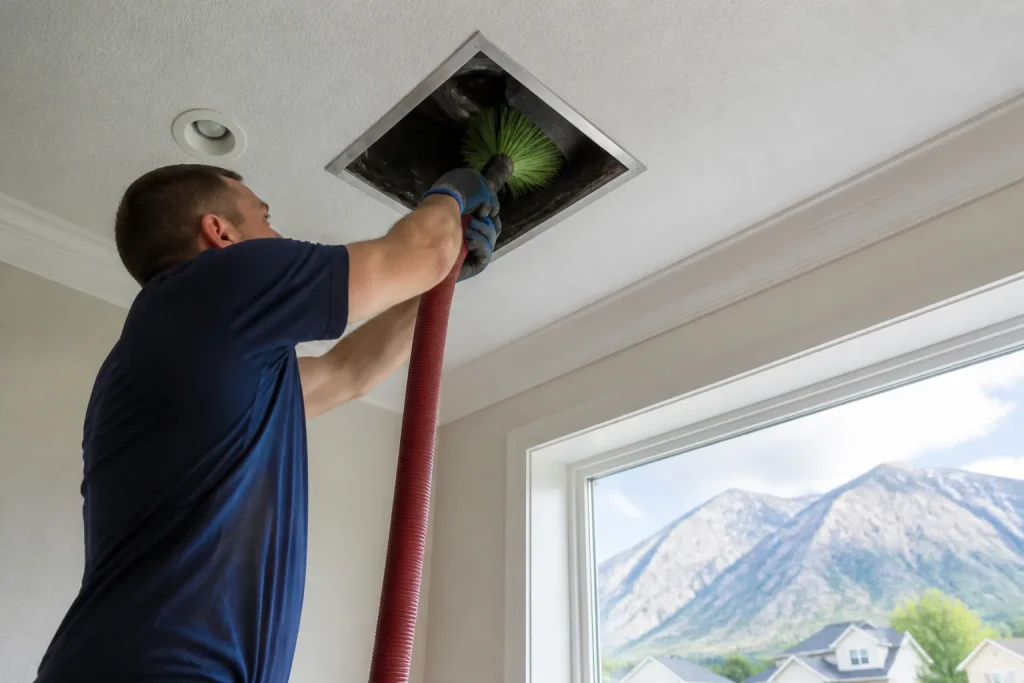
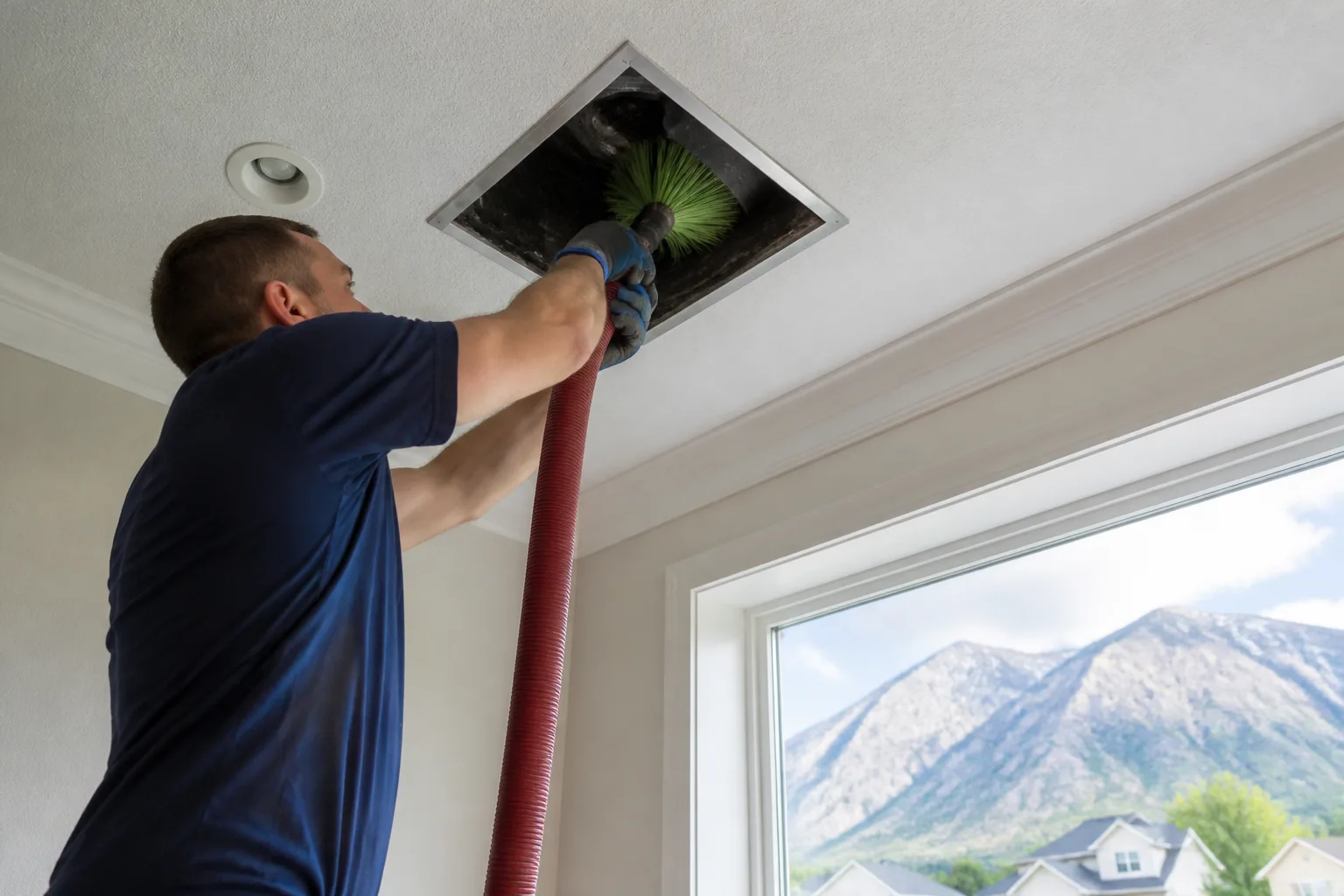
Air Duct Cleaning: Repair or Replace? How Saratoga Springs Homeowners Decide
Most homeowners ask us whether their ducts need cleaning, repair, or full replacement, and they usually ask it after someone has already quoted them one of the three. Here’s the honest answer: the right choice depends on your duct material, its age, and how much air it’s leaking, not on which service is easiest to sell. Clean first, seal second, replace only when the ductwork itself is failing. Below is the framework we use to sort one from the other in Saratoga Springs.
Start With the Duct Material, Not the Dust
The first decision gate is what your ducts are made of, because that determines whether cleaning can even be done safely. Most homes in Saratoga Springs built in the last few decades use flex duct in the attic runs and sheet metal at the trunk. Flex duct has a plastic inner liner that carries the air and a wire coil that holds its shape. That liner is the part that matters. When it’s intact, cleaning is straightforward. When it’s degraded, agitation can tear it, and you end up with insulation fibers blowing into your living room. Not the upgrade anyone had in mind.
Older rigid sheet metal is the opposite story. It’s tough, cleanable, and usually worth saving. The weak points are the seams and joints, which is where leakage starts. Knowing which material you have in which part of the house is step one before anyone touches a brush.
- Flex duct: cleanable when the inner liner is smooth, shiny, and intact. Risky when it’s brittle, cracked, or coated in insulation dust.
- Rigid sheet metal: durable and repairable. Leaky seams are fixable, not a reason to replace.
- Ductboard: clean lightly and inspect closely. Crumbling board is a replacement sign.
How Old Is Too Old for Flex Duct?
Flex duct older than 15 to 20 years is the point where we stop assuming it can be cleaned and start checking whether the liner has already given up. A lot of homes around Saratoga Springs sit right at that age, and it’s not only time that wears the duct out. Attics here see intense high-altitude sun through the roof deck, and UV breaks down the plastic liner faster than the national average suggests. Ducts routed up high with little shading take the worst of it.
Here’s the car-detailing comparison we keep coming back to: cleaning a duct system that’s leaking a big share of its conditioned air into an unconditioned attic is like paying for a full detail on a car with a cracked engine block. The paint looks great. The problem is still under the hood. In Saratoga Springs, the attic is the engine bay, because that’s where the heat goes to die and where duct leaks cost you money on every summer cooling cycle.
If your flex duct is past that 15-to-20-year window, the honest next step is an inspection of the liner, not an immediate cleaning. Push a camera or a hand down a run and look at the inside wall. Smooth equals cleanable. Chalky or flaking equals plan for replacement of that run.
What a Duct Leakage Test Tells You That a Visual Check Can’t
You can look at a duct all day and still miss the leaks that matter. A visual inspection shows you dust, kinks, and disconnected runs. It does not tell you how much air is escaping. A blower door test with a duct blaster pressurizes the duct system and measures leakage directly, which turns a guess into a number you can act on before you commit to cleaning or replacement.
When is the test worth the cost? We recommend it in three situations:
- Your energy bills have crept up and you can’t pin down why.
- Some rooms never get comfortable no matter what the thermostat says.
- You’re about to spend real money on cleaning and want to know if the ducts are worth cleaning in the first place.
A leakage test in Saratoga Springs often pays for itself by keeping you from cleaning a system that needs sealing first, or by showing you the ducts are tight enough that a good air duct cleaning is all that’s needed. Numbers beat eyeballs.
The Middle Path: Clean, Then Seal
Replacement is not the only fix for leaky ducts, and it’s rarely the first one. If your ductwork is structurally sound but leaking at the seams, joints, and boots, cleaning followed by sealing gets you most of the way to new-system performance for a fraction of the disruption. That’s the middle path, and it’s the one we recommend more than either extreme.
Two sealing approaches cover most homes. Mastic sealing is a brush-on compound applied to accessible joints and connections, done by hand. Aerosol-based sealing reaches leaks hidden inside walls and chases that no one can physically get to. Either way, the sequence matters: clean the ducts first, then seal, then verify. Sealing over a dirty duct just traps the debris behind a layer of mastic and calls it done.
When does the middle path make sense? When the duct material is intact, the leakage is concentrated at joints, and the runs aren’t crushed or undersized. When does it not? When the liner is failing, or the layout itself is the problem. Full HVAC cleaning and sealing together also keep your equipment from working harder than it should while fighting leaks.
Saratoga Springs Attic Conditions and What They Do to Ducts
Attics here are not gentle on ductwork. Summer sun through the roof deck and the wide temperature swings between day and night work the flex duct liner and the tape at every joint. UV exposure speeds up the breakdown of the plastic inner wall, so a system that would last 20 years in a milder climate can show liner failure sooner in a Saratoga Springs attic that bakes all afternoon. Runs stretched tight across a hot south-facing roof pitch are the first to go.
The practical takeaway is to inspect the attic runs before assuming a cleaning is going to help. Look at the duct in the sunniest part of the attic first. If the liner is chalky, cracked, or coated in insulation dust, cleaning that run isn’t a service, it’s a risk. If the liner is smooth and the joints are taped, an attic flex run is a good cleaning candidate, and a check of the dryer vent cleaning run while you’re up there saves a second trip.
How to Read a Duct Cleaning Company’s Inspection Report
The report is where you find out whether a recommendation is grounded in what’s actually in your ducts or in what the company happens to sell. A company that only cleans will find cleaning is warranted. A company that only replaces will find replacement is warranted. Read the report for these markers:
- Photos of the inside of the ducts, not just the vent covers. The liner condition should be visible.
- Material and age noted per run, not a single blanket verdict for the whole house.
- Leakage numbers or a description of what was tested, not just “leaks found.”
- A repair-and-seal option offered alongside cleaning and replacement. If those are the only two choices, ask why the middle path is missing.
- Specific findings you can verify, like a disconnected run or a crushed section, with the location named.
Our own reports read this way because our team handles cleaning, repair and sealing, and air quality work under one roof. We use professional-grade equipment from Rotobrush and Nikro to clean, and we fix what we find rather than recommending a replacement when sealing will do. When the ducts need sanitizing for mold or allergens, we bring in Abatement Technologies and Guardsman protocols, which standard cleaning alone can’t address.
When to Call a Pro
If you’re not comfortable pulling a section of flex duct or reading a liner up close in a hot attic, that’s the point to call. Duct work isn’t dangerous like a gas line, but getting it wrong wastes money and can put fiberglass into your air. Call (844) 542-4260. We answer 24/7. Fast dispatch from 7am to 7pm, Sunday through Friday. If you’d rather start with a service, see our broader work at Saratoga Springs Air Duct Cleaning Pros.
The Bottom Line
Decide in this order: material first, then liner condition, then leakage, and only then cleaning versus repair versus replacement. Most Saratoga Springs homes fall into the clean-and-seal category, a smaller number need just a good cleaning, and full replacement is reserved for ductwork whose liner or layout has actually failed. Ask for photos, ask for leakage numbers, and ask why the middle path isn’t on the table if it’s missing. If you’re in Saratoga Springs and need help, Saratoga Springs Air Duct Cleaning Pros offers free estimates. Call (844) 542-4260. We answer 24/7. Fast dispatch from 7am to 7pm, Sunday through Friday.
Frequently Asked Questions
Check the duct material and the condition of the inner liner first: intact liner means cleaning and possibly sealing, and a degraded or chalky liner means replacing that run. A duct leakage test settles the question with numbers when a visual check isn’t enough. Call (844) 542-4260 for an exact quote. Estimates are free.
Yes, when the inner liner is smooth and intact. Flex duct older than 15 to 20 years, or liner cracked by attic sun and heat, can rupture under cleaning agitation, so it’s inspected before anyone cleans it. If a run fails the check, we tell you and quote replacement for that run instead.
Sealing is almost always the lower-cost path when the ductwork is structurally sound and the leaks are at joints. Replacement is reserved for failed liner, crushed runs, or a layout that can’t be fixed. We set one flat price per job by written estimate, so you see the number before any work starts.
For most homes, every few years is enough, and often longer if the system is sealed and filtered well. Post-renovation dust, a recent home purchase, or allergy symptoms are the usual reasons to move it up the calendar. Cleaning isn’t a subscription, it’s a fix for a specific condition. Call (844) 542-4260 for an exact quote. Estimates are free.
Written by the team at Saratoga Springs Air Duct Cleaning Pros.
Need Air Duct Cleaning Help?
Call Saratoga Springs Air Duct Cleaning Pros - the local pro we connect you with is licensed and insured, with free written estimates in Saratoga Springs.
(844) 542-4260