
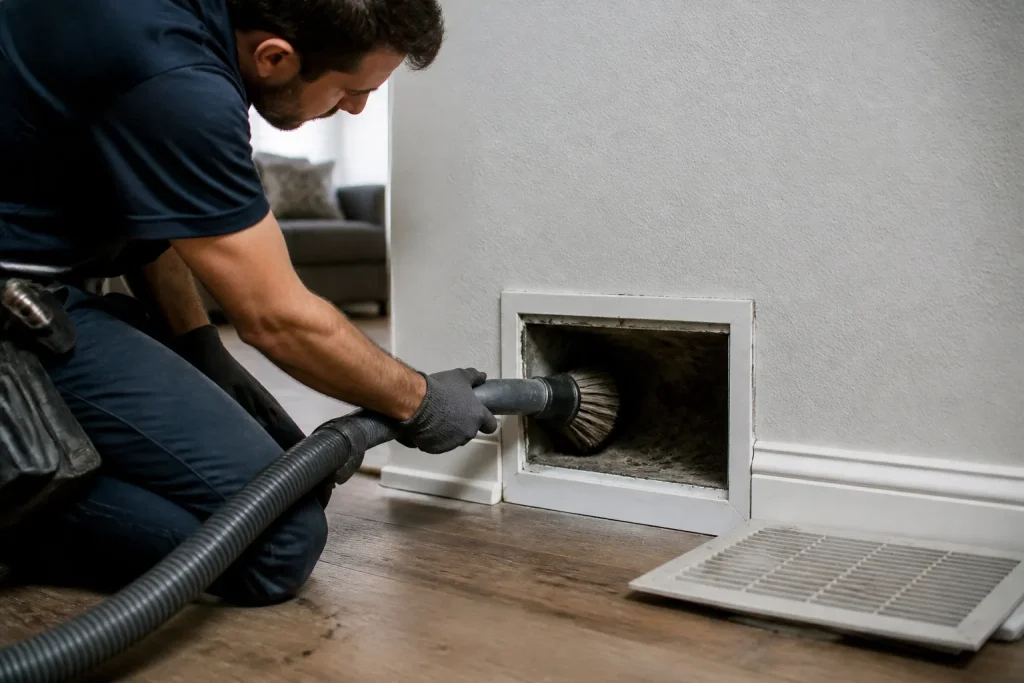
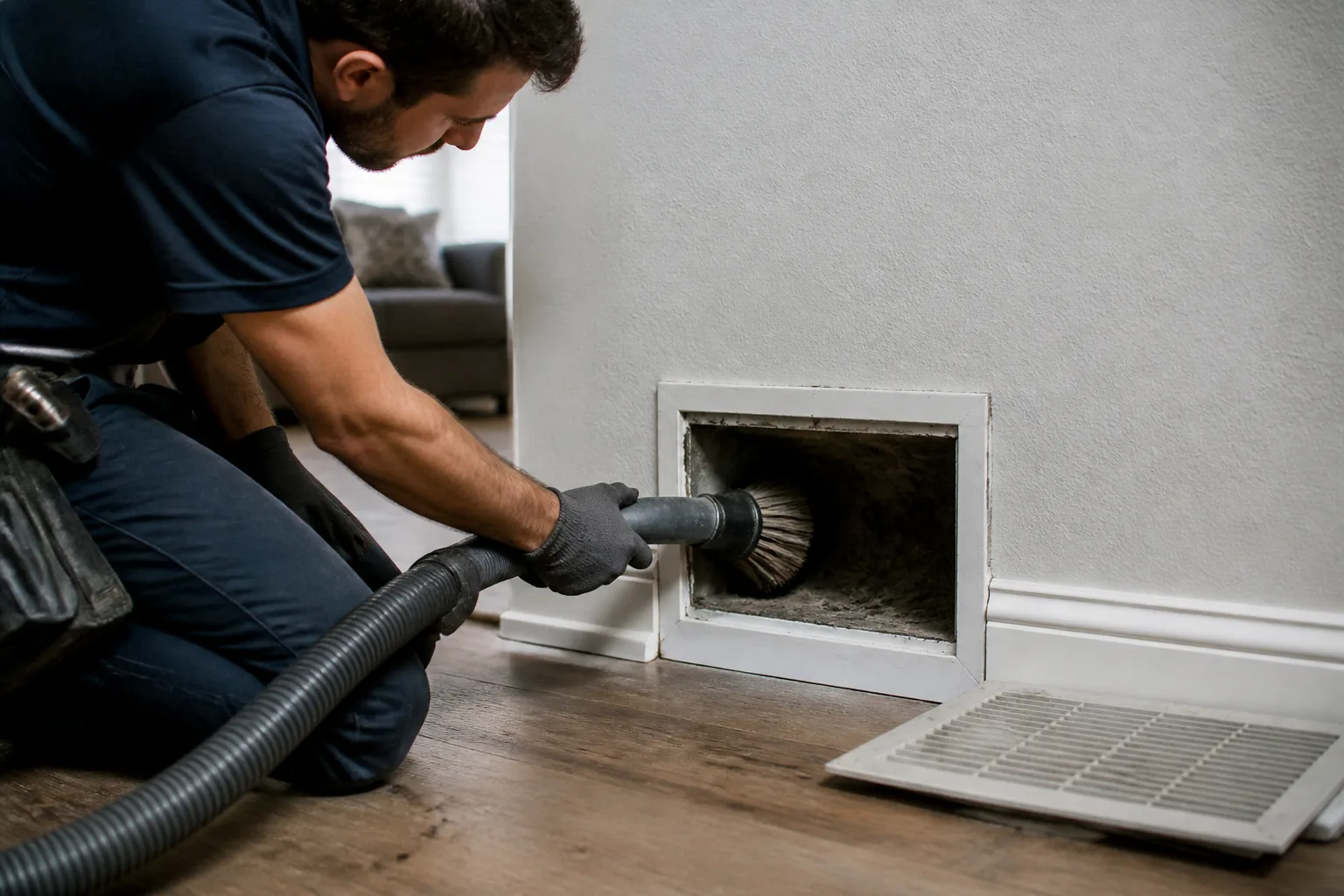
Top Signs You Need Air Duct Cleaning Service – Don’t Ignore These
Dust reappearing on furniture 48 hours after cleaning isn’t a housekeeping problem. It’s your supply registers redistributing a debris load that’s been sitting in the trunk line, possibly for years. Most “signs you need duct cleaning” lists stop at the symptom and never explain the mechanics behind it, which leaves homeowners either dismissing real warning signs as normal or paying an HVAC contractor to chase a problem that lives in the ducts. Here’s what’s actually happening inside the system when each sign shows up.
If you’d rather have someone look instead of taking notes with a flashlight, call (844) 542-4260. We answer 24/7.
Why does dust come back so fast after you clean?
Because the dust you’re wiping up was never coming from the room in the first place. Your return grille pulls air from the living space, and that air passes through the return duct before it ever reaches the filter. When the return and trunk line carry a settled layer of debris, every heating and cooling cycle lifts a little of it and pushes it back out through the supply registers. You dust, the system re-dusts, and the cycle repeats.
The tell is timing. Ordinary household dust settles slowly over days. Dust that returns within a day or two, especially on horizontal surfaces directly under or near a register, is being deposited by airflow. Run your finger across a shelf above a supply vent and then across a shelf in a room with no vents nearby. If the vent-side shelf builds up noticeably faster, the debris source is the duct system, not your cleaning routine.
What this looks like in Saratoga Springs new construction
Homes built during the recent construction boom around Saratoga Springs often show this sign earlier than older houses do. Builder-grade duct installs typically get a rough pass during construction, and drywall dust, sawdust and framing debris from the build aren’t always cleared before the system goes into service. Debris signs can show up within three to five years of a home being finished. A new house with a dusty register problem isn’t a mystery, it’s a leftover.
The 90-second return grille check
Any homeowner can do this. It takes about a minute and a half and tells you more than most online checklists will. You don’t need to remove anything or climb into the attic.
- Turn the system off at the thermostat so dust isn’t moving while you look.
- Take a flashlight and look into the return grille (the large intake vent, usually in a hallway or central wall).
- Shine the light along the visible duct surface just past the grille opening.
- Look at the filter slot and the edges around it.
What you’re looking for: a visible mat of dust or fuzz on the duct walls past the grille, debris piled at the bottom edge of the opening, or a filter that looks gray and loaded before its replacement interval. If the duct surface past the grille looks like a felted layer rather than a light film, there’s enough material in the system to affect both air quality and airflow. That’s the point where a professional look makes sense. In our experience, this quick check catches more real problems than any symptom list, including the ones in this article.
Why are some rooms always cold or warm?
Inconsistent room temperatures are usually a duct restriction problem before they’re an HVAC capacity problem. A furnace or heat pump that heats some rooms fine has the capacity to heat all of them. When one room stays stubbornly cool, the air isn’t reaching it, and the cause is somewhere between the plenum and the register.
The common restrictions: a branch duct that’s crushed or kinked during installation, a partially closed or failed damper, disconnected or leaky duct joints sending conditioned air into the attic or crawlspace instead of the room, or heavy debris buildup narrowing the run. A system with leaks and disconnected joints is losing air before it arrives, which is why simply turning up the thermostat doesn’t fix the cold room.
How to tell a duct restriction from an HVAC problem
- Restriction signs: the room is consistently off while others are fine, register airflow feels weak at that room but strong elsewhere, the furnace runs normally without short-cycling, and the problem developed gradually or after a renovation.
- HVAC signs: the whole house struggles at once, the system short-cycles, the blower sounds labored, or performance drops suddenly after a repair.
If airflow at one register is weak while another on the same system blows hard, that’s a duct question. If every register is weak at the same time, that’s an equipment or filter question. Getting this distinction right saves money, because replacing equipment won’t fix a crushed branch duct, and cleaning ducts won’t fix a failing blower.
What does the smell coming from your vents mean?
Smell is where homeowners most often misdiagnose. A musty odor that only appears when the HVAC kicks on is a different problem than a musty smell that’s there all the time.
Odor that appears only when the system runs points to the supply path: debris, dust or microbial growth sitting on duct surfaces or in the air handler getting stirred into the airstream each cycle. When the blower stops, the smell stops. The source is inside the system, and it’s being moved by airflow.
Odor that’s present whether or not the system runs usually points to a moisture source outside the ductwork: a damp crawlspace, a leak, poor drainage, or an area of the home with a humidity problem. Cleaning the ducts won’t remove that smell because the ducts aren’t producing it. Find the moisture first.
There’s also the dead-animal smell, which is exactly what it sounds like and needs a different response than routine cleaning. A persistent, sharp, organic odor like that warrants an inspection of the system for the source before anything else is scheduled.
When cleaning isn’t enough: signs you also need repair or sealing
This is the distinction most articles skip, and it’s the one that causes repeat problems. Some signs mean the ducts need cleaning. Other signs mean the ducts need cleaning plus repair or sealing, and treating the second as the first leaves you scheduling the same job again in a year.
Signs that point to repair or sealing rather than cleaning alone:
- Visible gaps, separated joints or disconnected sections in accessible ductwork
- Dust streaks or dark lines at duct seams, which show air escaping (or being drawn in) at that point
- Rooms that stay off-temperature even with clean ducts and good airflow at the register
- Debris returning quickly after a cleaning, which suggests unfiltered air is being drawn in through leaks
- Duct runs that pass through unconditioned attic or crawlspace space, where leaks cost the most
Cleaning removes the debris load. Sealing and repairing stop the leaks that let new debris in and let conditioned air out. A system that gets cleaned but not sealed can look clean on day one and be re-contaminated within a heating season. When we assess a Saratoga Springs home, we check both, because fixing the source is what makes a cleaning last.
When to call a pro in Saratoga Springs
Call a professional when any of these are true:
- You’ve done the return grille check and found a visible layer of debris past the opening
- Dust returns to surfaces within a day or two of cleaning, especially near registers
- One or more rooms consistently run hot or cold while the rest of the house is fine
- A musty smell appears whenever the system runs
- You’ve recently finished a renovation or moved into a newly built home
Two other reminders. Dryer vent cleaning belongs on the same list: lint accumulation in the vent is a leading cause of residential fires and gets missed by companies that only handle ducts. And a system that smells musty or has visible microbial growth needs sanitizing and air-quality work, not just vacuuming. We use Guardsman and Abatement Technologies equipment for those jobs, with negative-air containment to keep the process controlled.
Our technicians have up to 8 years of experience, and we use professional-grade Rotobrush and Nikro systems rather than consumer-grade equipment. If you’d rather have a specialist take a look than climb into the attic yourself, call (844) 542-4260. We answer 24/7. Fast dispatch from 7am to 7pm, Sunday through Friday.
Related services in Saratoga Springs: if the inspection points to routine debris, air duct cleaning is the starting point. If lint is the concern, dryer vent cleaning handles that separately. If the air handler itself is carrying the buildup, HVAC cleaning covers the equipment end. We’re Saratoga Springs Air Duct Cleaning Pros, and one call covers the whole air system.
The Bottom Line
Dust that returns fast, uneven room temperatures, a system-triggered musty smell, and debris visible past the return grille are the four signs that most reliably point to duct debris as the source. But the detail that matters most is whether the problem is debris alone or debris plus leaks and damage. Cleaning a leaky system without sealing it brings the same signs back. And in Saratoga Springs homes finished during the construction boom, builder-grade ductwork with uncleared construction dust can produce these signs within a handful of years, not decades.
If you’re seeing any of these signs in your Saratoga Springs home and want a straight assessment rather than a sales pitch, we offer free estimates. Call (844) 542-4260. We answer 24/7, and dispatch runs 7am to 7pm, Sunday through Friday.
Frequently Asked Questions
Most homes need it every three to five years, but the right interval depends on your situation, not a calendar. New construction, recent renovations, pets, allergies, and a leaky duct system all shorten the interval. A home with visible debris at the return grille and fast dust return needs attention now regardless of when it was last cleaned. Call (844) 542-4260 for an exact quote; estimates are free.
It depends on the size of the system and whether the job needs cleaning alone or cleaning plus repair and sealing, which is why we set one flat price per system agreed before work starts, not a per-vent rate. We won’t quote you a teaser figure and change it after the technician is on site. Call (844) 542-4260 for an exact quote; estimates are free.
Cheap quotes usually skip the parts of the job you can’t see from the driveway: the trunk line, the air handler, the return side, and any sealing work the system needs. Some don’t include professional-grade equipment. A thorough job has real time and equipment behind it. Ask whether the quote covers repair and sealing assessment, and ask to see before-and-after photos of your own ducts. Call (844) 542-4260 for an exact quote; estimates are free.
You ask for before-and-after photos of your own duct system, taken during the job, not stock images. We document the work that way because the industry’s bait-and-switch reputation is well earned by some operators. You should also be able to see the equipment and ask what it performs. Our work uses Rotobrush and Nikro systems and Honeywell and Aprilaire air-quality products where they fit, and the process is explained to you before it starts. Call (844) 542-4260 for an exact quote; estimates are free.
Written by the team at Saratoga Springs Air Duct Cleaning Pros.
Need Air Duct Cleaning Help?
Call Saratoga Springs Air Duct Cleaning Pros - the local pro we connect you with is licensed and insured, with free written estimates in Saratoga Springs.
(844) 542-4260